
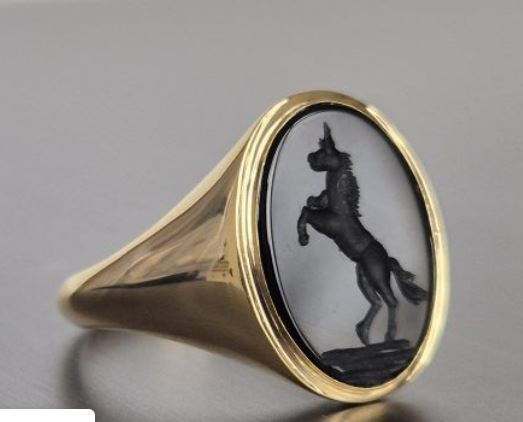
Signet Ring is a timeless piece of jewelry featuring a flat, personalized face—traditionally engraved with a family crest, monogram, or unique symbol—that historically served as an official signature to stamp wax seals on important documents. Once reserved exclusively for nobility, religious leaders, and the social elite, these rings functioned as the ancient world’s equivalent of a legal fingerprint or a digital signature. In the modern era, while the practical need for wax seals has vanished, the signet ring has undergone a massive style renaissance. Today, it stands as one of the most powerful, sophisticated fashion statements available, seamlessly blending rich historical heritage with contemporary minimalist luxury.
The Fascinating History and Modern Renaissance
The origins of the signet ring date back thousands of years, with early iterations found in ancient Egypt, where pharaohs wore rings bearing the cartouche of their divine authority. By the Middle Ages and the Renaissance period, they had become indispensable tools for the European aristocracy. Every influential family possessed a distinct coat of arms, and the reverse-engraved (intaglio) signet ring allowed them to press their mark into hot wax, ensuring the authenticity and confidentiality of correspondence. Because these rings were often destroyed upon the owner’s death to prevent forgery, genuine antique pieces are exceptionally rare today.
In contemporary fashion, the signet ring has broken free from the rigid confines of aristocratic lineage. While many individuals still wear them to honor their family genealogy, others use the flat canvas of the ring to express personal identity. Modern signets feature everything from abstract geometric patterns, zodiac signs, and spiritual symbols to completely clean, unengraved faces that showcase the raw beauty of the polished metal.
How to Choose the Perfect Signet Ring
When selecting or designing a signet ring, several structural and aesthetic elements should be taken into consideration to match your personal style:
- The Shape of the Face: The shape of the ring’s face defines its overall character. An oval face is the most traditional and classic option, offering a soft, elegant look. A cushion shape (a square with gently rounded corners) provides a bold, vintage aesthetic, while a round face offers a sleek, modern, and minimalist vibe.
- The Material: High-quality precious metals are essential for an item meant to be worn daily. Traditionalists typically opt for the royal warmth of 14k or 18k yellow gold. For a cooler, understated luxury, sterling silver, white gold, or platinum are excellent choices that make intricate engravings stand out sharply.
- Engraving Methods: If you choose to personalize your ring, you can opt for laser engraving, which offers mathematical precision for complex modern graphics, or traditional hand engraving, where a master jeweler carves the metal to create a deep, artisanal texture that ages beautifully.
Frequently Asked Questions About Signet Rings
Navigating the rules and traditions of heritage jewelry can raise several questions. Here are the most common inquiries regarding signet rings answered:
1. Which finger are you traditionally supposed to wear a signet ring on?
Answer: According to historical European and British traditions, a signet ring is worn on the pinky finger (the smallest finger) of the non-dominant hand. This placement made it physically effortless for the wearer to quickly press the ring into hot wax on a desk. However, modern fashion rules are entirely subjective. Today, people confidently wear signet rings on the ring finger, middle finger, or even the index finger, depending entirely on personal comfort and style preference.
2. Can anyone wear a signet ring, or do you need a family crest?
Answer: Anyone can wear a signet ring. While they were historically tied to familial coats of arms, modern jewelry celebrates individuality. You can choose to leave the face completely blank for a polished, minimalist look, engrave your own initials in a stylized monogram, or select a meaningful symbol—such as a lion for courage or an anchor for stability—that reflects your personal journey.
3. What is the difference between positive and negative (intaglio) engraving?
Answer: A positive engraving carves the design normally into the metal so that it reads correctly when you look directly at your hand. A negative, or intaglio, engraving carves the design in reverse (a mirror image) and with deep relief. Intaglio is the traditional method used if you actually want to press your ring into hot wax, resulting in a correctly oriented, raised wax seal.
4. Are signet rings only meant for men?
Answer: Absolutely not. While signet rings were historically associated with male patriarchs due to the legal nature of signing documents in the past, they are completely gender-neutral today. Women’s signet rings often feature slightly slimmer bands and smaller, more delicate faces, offering a chic, tailored look that pairs beautifully with casual wear or sophisticated evening attire.
Investing in a high-quality signet ring is more than a simple jewelry purchase; it is the acquisition of a personal trademark that grows more character with every scratch and patina earned over a lifetime of wear. Whether you are looking for a classic gold piece to pass down to future generations, a modern silver ring for everyday accessorizing, or a custom-engraved emblem that tells your unique story, finding the right craftsmanship is paramount. You can easily browse our premium collection of Signet Ring products and similar custom heritage jewelry on our website, where you can choose the perfect design to express your individuality.